Yes. The interview can happen by video, and many personal commissions are conducted entirely by correspondence. Hospitality projects require at least one in-person site visit.
Bespoke Perfumery — Grasse & by Correspondence
A signature scent,
composed — not chosen.
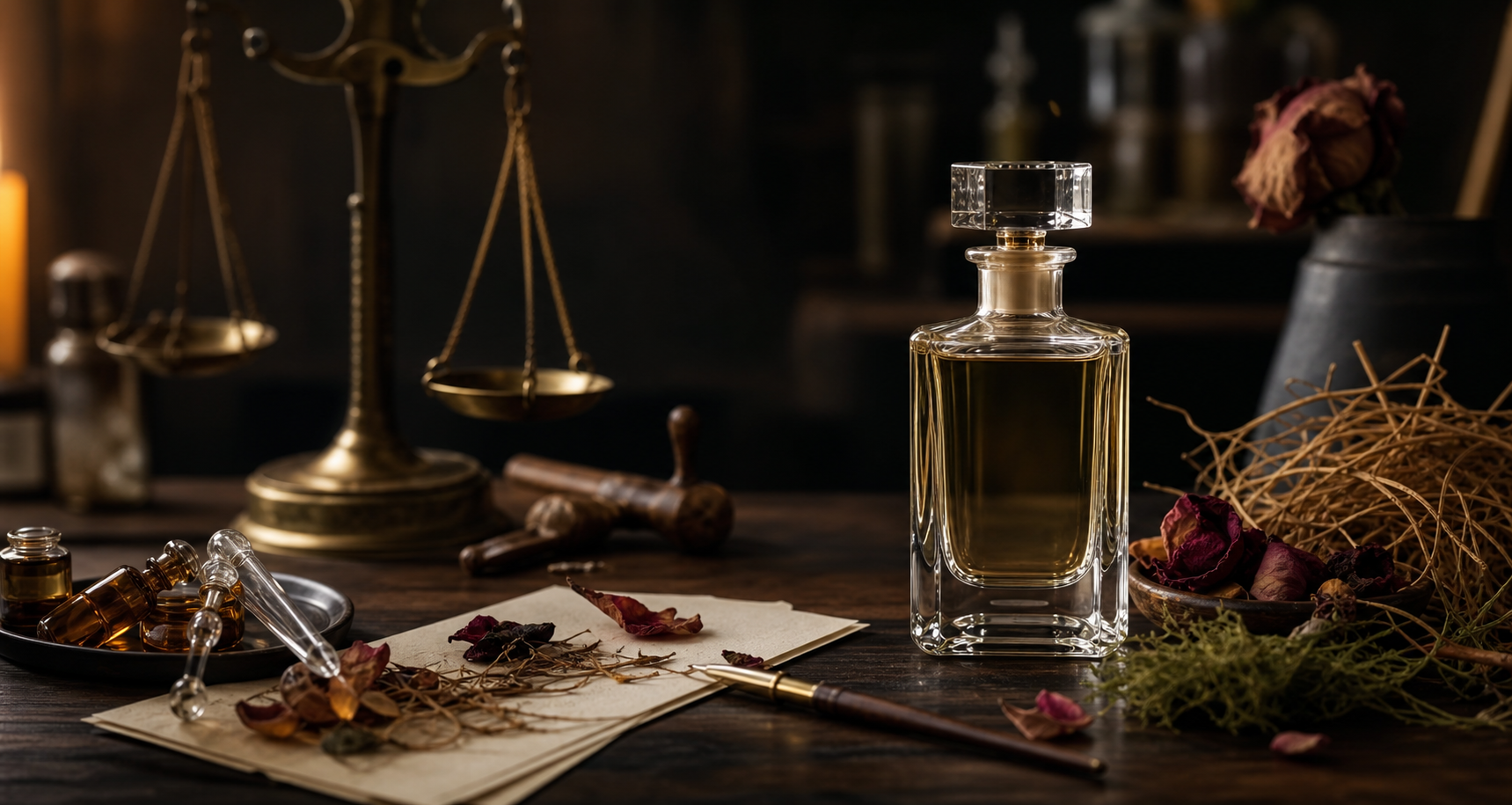
Atelier Vesper builds a fragrance the way a tailor builds a coat: from measurements only you carry — the rooms you grew up in, the years you'd rather not name, the one smell that still stops you on a street corner. Nothing here is selected from a list.
Limited to twelve personal commissions a year.
Current Slate
8 of 12 personal commissions reserved.
The Offering
Three things made here, and nothing else.
I
Bespoke Personal Fragrance
A single fragrance, composed over six to ten weeks through a structured memory interview, refined across three sittings, and bottled once — for one person.
Learn the process
II
The Ready-to-Wear Collection
Five fragrances kept in permanent rotation, each built around one idea rather than a season. No reformulations, no limited editions chasing a trend.
View the collection
III
Hospitality & Retail Scent Direction
An olfactory identity for a room, not a bottle — built for boutique hotels, restaurants, and shops who want to be recognised with the eyes closed.
See the workInteractive Scent Study
Move the formula and watch the accord change.
A simplified atelier sketch: balance memory, material, and atmosphere to see how a brief starts to find its shape.
Fig, paper, and quiet cedar
Fresh green lift over a tactile paper heart, grounded by polished wood.
The Philosophy
Memory outperforms the mood board.
"Ask someone what they want to smell like, and they'll describe an advertisement. Ask what they remember, and you'll have a fragrance."
— Margaux Ferrand, Founder & Perfumer
Margaux trained for twelve years inside a perfumery house in Grasse before leaving to found Atelier Vesper — a deliberate rejection of the algorithmic "build your scent" quizzes that now dominate the personalised fragrance market.
Where those services match you to a formula in minutes, the atelier works in weeks: one perfumer, one client, three sittings, and a structured interview built to surface the smells you've stopped noticing because you've never left them.
Read about the Atelier →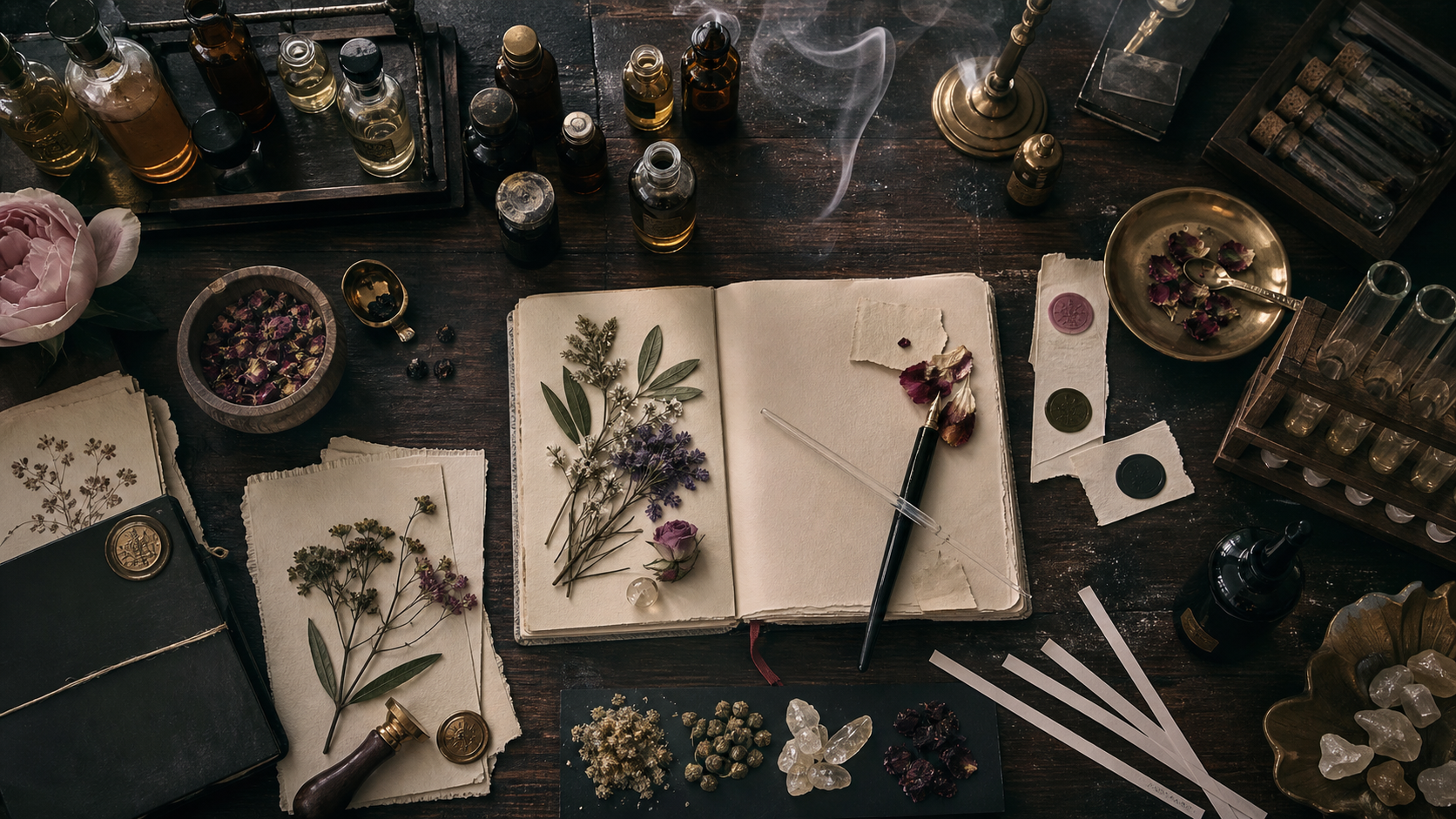
Materials Library
Every brief becomes a working table.
Notes are tested on paper, then on skin, then against the memory that started the commission.
The Process
Four sittings. No shortcuts.
Every bespoke commission, personal or hospitality, follows the same four-stage structure — refined over a decade and never rushed for a deadline.
See the full process in detail →I
The Interview
Two hours, recorded in longhand — places, seasons, the smells you've never had a word for.
II
The Composition
Margaux builds the first accord alone, away from the brief, against her own working library of materials.
III
The Sitting
Three rounds of adjustment, worn on skin over days, never judged in the room on first contact.
IV
The Bottling
One batch, hand-labelled, with the formula archived under your name and never resold.
Selected Commissions
Recent work, in rooms and on people.
Hospitality
Hôtel Sainte-Ursule, the Luberon
An eleven-room hotel wanted a scent that read as "the building," not "a brand." We built it from the limewash on its walls and the fig trees in its courtyard.
Read the case study →Retail
Maison Verlaine, Lyon
A bookshop-café asked for a scent that wouldn't compete with the coffee. The brief became the constraint, and the constraint became the idea.
Read the case study →From the Notes
Writing on the trade, occasionally on its history.
Six weeks. Three sittings.
One bottle that didn't exist before you asked.
The Atelier
Twelve years at someone
else's bench, then a decision.
Margaux Ferrand founded Atelier Vesper in 2021, after a decade inside a perfumery house in Grasse convinced her that the industry's fastest-growing idea — algorithmic personalisation — was solving the wrong problem.
MF
Margaux Ferrand
Founder & Perfumer
Margaux apprenticed at a century-old perfumery house in Grasse at twenty-two, eventually composing for three of its private-client lines under other names — the standard arrangement in an industry where the "nose" is rarely the name on the bottle.
By thirty, she was watching the same houses launch direct-to-consumer arms built on five-minute quizzes: pick a mood, pick a fruit, receive a formula assembled from a finite library of pre-approved accords. Fast, scalable, and — to her — closer to a vending machine than a perfumer.
Atelier Vesper is the deliberate opposite: one perfumer, a handful of clients a year, and a process built around a structured interview rather than a multiple-choice form. It is slower on purpose, and it has stayed small on purpose.
A Short History
How the atelier got here.
2011
Apprenticeship, Grasse
Begins training under a master perfumer at a historic Grasse house, the traditional centre of French perfumery.
2016
Private-Client Composition
Composes for the house's private-client division — formulas sold under other names, as is standard in the trade.
2019
The Departure
Leaves to compose independently, unwilling to fold her client work into an algorithmic personalisation line.
2021
Atelier Vesper Founded
Opens for personal commissions only, capped at twelve a year, working from a small studio outside Grasse.
2023
First Hospitality Commission
Hôtel Sainte-Ursule, an eleven-room hotel in the Luberon, commissions the atelier's first scent identity for a space.
2025
The Ready-to-Wear Collection
Five fragrances from past commissions, generalised and released as a permanent, non-seasonal collection.
What The Atelier Won't Do
Refusal is also a design decision.
No hand-offs
One perfumer carries a commission from the first interview to the final bottle. No formula is passed to a junior "nose" partway through.
No reformulation
Once a personal formula is archived, it is never altered, repackaged, or quietly substituted to cut cost.
No gifting, no seeding
The atelier does not send bottles to press or influencers in exchange for coverage. Commissions are paid for, in full, by the people who wear them.
No expansion past twelve
The personal-commission slate is capped at twelve a year by design — the limit is the quality control, not a marketing device.
If the process makes sense to you, the next step is a conversation, not a form.
The Offering
Three services.
One method underneath.
Whether the result is a single bottle or a diffusion system for an eleven-room hotel, every commission runs through the same four-stage process described further down this page.
I
Bespoke Personal Fragrance
For one person, built from a structured memory interview rather than a list of moods or fruit. The most labour-intensive thing the atelier makes, and the reason it can only take twelve a year.
What's included
- — A two-hour recorded memory interview, in person or by video
- — Three composition sittings, worn on skin over several days between each
- — One final 50ml bottle, hand-labelled, plus a 15ml travel vial
- — Your formula archived permanently under your name, available for reorder
- — A short written "scent note" explaining the composition's structure
The current five
- Vesper No. 1 — Limewash & Fig
- Vesper No. 4 — Wet Stone Library
- Vesper No. 7 — Burnt Orange Peel
- Vesper No. 9 — Linen, Late August
- Vesper No. 12 — Cedar Drawer
II
The Ready-to-Wear Collection
Five fragrances, each generalised from an earlier personal commission once its owner agreed to let the idea — never the formula itself — be shared more widely. Kept in permanent rotation; nothing here is seasonal or limited.
See sizes & pricing
III
Hospitality & Retail Scent Direction
An identity for a room rather than a person — built from a site visit, not a brand deck. Recommends and specifies the right diffusion method for the space, rather than defaulting to a candle because that's easiest to sell.
What's included
- — A site visit and materials audit (surfaces, light, existing odours to work with or against)
- — Two to three accord directions, tested on-site rather than in a sample vial alone
- — A diffusion specification: cold-air system, linen spray, or candle, recommended on merit
- — A formula licensed exclusively to the property, never resold to a competitor nearby
- — An optional ongoing scent-direction retainer for seasonal adjustment
The Process, In Full
Four stages, regardless of the brief.
I
The Interview
Two hours, recorded in longhand rather than a form. For personal commissions: places, seasons, the smells you've stopped noticing. For hospitality: the building's materials, its hours, what it doesn't want to smell like.
II
The Composition
Margaux builds the first accord alone, away from the brief notes, against her own working library of materials — deliberately avoiding the instinct to compose "to spec."
III
The Sitting(s)
Worn on skin or tested in the room over several days, never judged on first contact in a meeting. Personal commissions get three sittings; hospitality projects two to three, on-site.
IV
The Bottling / Specification
One hand-labelled batch and an archived formula for personal work; a written diffusion specification and supplier contact for hospitality work. Either way, the formula stays on file under your name alone.
Before You Write In
A few things people usually ask.
The three sittings exist precisely so this doesn't happen at the end. If, after the third sitting, the composition still isn't right, the commission is paused rather than forced to a bottle — see the Investment page for how this affects payment.
Yes, for hospitality and retail clients. The case studies on the Commissions page are published with permission; several past projects remain unpublished at the client's request.
Within the EU and UK directly; further afield on request, noted on the Investment page alongside lead times.
Know which service you need? Good. The next step is a conversation.
Commissions
Three rooms, twelve people,
and the formulas in between.
A selection of hospitality and retail work, published with each client's permission, followed by the five fragrances of the permanent Ready-to-Wear Collection.
Hospitality & Retail
Hôtel Sainte-Ursule
An eleven-room hotel in the Luberon, Provence — a former olive mill
"Guests started asking for the candle. There isn't one."
— General Manager, Hôtel Sainte-Ursule
- Brief
- A signature scent for the lobby and rooms that read as "the building," not "a brand" — with no audible diffusion motors, in keeping with the property's quiet.
- Approach
- A site visit audited the limewash walls, old stone, courtyard fig trees, and the building's history as an olive press. The accord built around fig leaf, a mineral limewash note, and a trace of aged olive wood.
- Specification
- Passive cold-air diffusion embedded in the existing ventilation — no visible hardware, no motor noise.
- Result
- Installed across the lobby, restaurant, and all eleven rooms in 2023. The licence remains exclusive to the property.
Maison Verlaine
A bookshop-café in the Croix-Rousse district, Lyon
"Most people who comment on it think it's just how the shop smells. That was the point."
— Owner, Maison Verlaine
- Brief
- A scent with its own identity that wouldn't compete with coffee or old paper — and would distinguish the shop from a dozen similar cafés nearby.
- Approach
- Treated the "don't compete" constraint as the actual design problem. Composed a quiet vetiver-and-paper accord, deliberately low in projection.
- Specification
- Diffused only near the entrance rather than throughout — greets arriving guests without lingering over the tables.
- Result
- A second, stronger composition has since been commissioned for the shop's evening event space.
Onze
A 24-cover restaurant in Antwerp
"We wanted memory, not reviews about the candle."
— Co-Owner, Onze
- Brief
- A scent for the entryway and washrooms only — present enough to register, never strong enough to interfere with the tasting menu.
- Approach
- Composed around toasted hazelnut and dark florals that echo the menu without literally smelling like food.
- Specification
- Linen spray limited strictly to entry and washroom zones — the dining room itself stays entirely scent-neutral.
- Result
- This two-zone model is now the atelier's reference approach for restaurant clients managing strong kitchen odours.
The Ready-to-Wear Collection
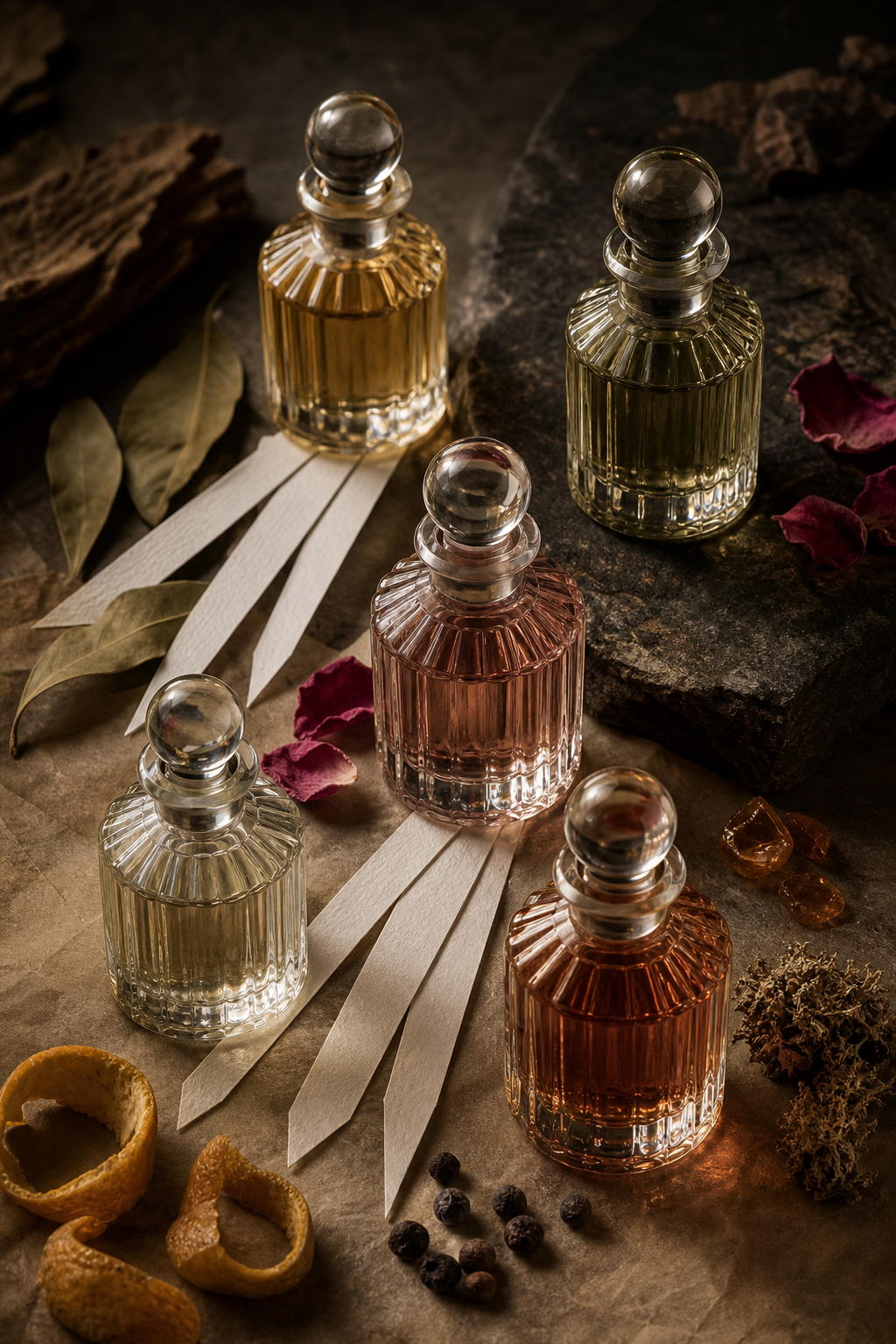
Five fragrances, kept in permanent rotation.
Vesper No. 1
Limewash & Fig
Top — Green Fig Leaf, Bergamot
Heart — Fig Milk, Orris
Base — Cedar, White Musk
€185 / 50mlInquire
Vesper No. 4
Wet Stone Library
Top — Rain-Wet Granite Accord, Iris
Heart — Old Paper, Vetiver
Base — Oakmoss, Labdanum
€185 / 50mlInquire
Vesper No. 7
Burnt Orange Peel
Top — Blood Orange, Black Pepper
Heart — Orange Blossom, Smoked Tea
Base — Vetiver, Benzoin
€185 / 50mlInquire
Vesper No. 9
Linen, Late August
Top — Crushed Linen Accord, Petitgrain
Heart — White Tea, Hay
Base — Soft Musk, Cedar
€185 / 50mlInquire
Vesper No. 12
Cedar Drawer
Top — Cedar Shavings, Cardamom
Heart — Iris Root, Tobacco Leaf
Base — Labdanum, Vetiver
€185 / 50mlInquire
Looking For Something Else
None of these quite it?
That's what the bespoke commission is for — these five exist because someone else's memory shaped them first.
See Bespoke Commissions →A property, a shop, or a person — the first step is the same conversation.
Investment
What each commission costs, and why.
Personal commissions are priced for twelve a year, not twelve hundred. Figures below are starting points — your written quote follows the interview, once the scope is actually known.
Bespoke Personal Fragrance
Three ways to commission.
The Interview
One fragrance, the full process
€1,800
- Two-hour memory interview
- Three composition sittings
- 50ml bottle + 15ml travel vial
- Formula archived under your name
Most Commissioned
The Wardrobe
Three fragrances, one extended engagement
€4,200
- One combined interview, three formulas
- Day, evening & travel compositions
- Three sittings per fragrance
- 3× 50ml bottles, all three archived
The Heirloom
For two, from one set of memories
€6,500
- Your full bespoke fragrance
- A companion fragrance for someone named in your interview
- Keepsake presentation box, hand-finished
- Both formulas archived for descendants to reorder
Hospitality & Retail Scent Direction
Priced per property, billed in two parts.
Signature Scent Development
From €5,400, scoped after the site visit
- — Site visit and materials audit
- — Full four-stage composition process
- — Diffusion method specification
- — Formula licensed exclusively to your property
Scent Direction Retainer
€650 per quarter, optional, cancel anytime
- — Seasonal adjustment to the existing formula
- — Supply & refill coordination
- — Priority scheduling for additional spaces
- — Direct line to the atelier, not a support inbox
Ready-to-Wear Collection
Sizes & pricing.
Full Bottle
€185
50ml, any of the five compositions
Travel Size
€65
15ml, any of the five compositions
Discovery Set
€95
5× 5ml, one of each composition
Payment, Deposits & Shipping
The practical terms.
Personal commissions require a 30% deposit to book the interview; the balance is due on final bottling, not before.
If a composition still isn't right after the third sitting, the commission pauses rather than continuing to a bottle. The deposit covers the work already completed; the remaining balance is never charged, and nothing is produced or shipped.
Hospitality projects are billed 50% on signature and 50% on delivery of the diffusion specification.
Shipping for the Ready-to-Wear Collection is direct within the EU and UK. Further afield is available on request; customs duties, where applicable, are the recipient's responsibility.
Figures settled. The next step is still a conversation.
Notes
Writing on the trade,
occasionally on its history.
Short, occasional notes from the atelier — on materials, on process, and on the parts of perfumery that rarely make it into a product description. Click an entry to read.
Real ambergris — the waxy substance occasionally recovered from sperm whale digestion — has been functionally absent from serious perfumery for decades, for reasons that need no explaining. What replaced it almost everywhere was a class of synthetic fixatives, ambroxan chief among them, prized for a clean, almost weightless musk-amber character at a fraction of the cost.
The trouble isn't ambroxan itself. It's that, by the mid-2010s, it had become so ubiquitous across mass and niche perfumery alike that an enormous share of "modern" fragrances share the same base signature, whether their brief called for it or not. It became a default, the way a particular shade of warm cream became a default for a certain kind of website. Useful, pleasant, and increasingly invisible as a choice.
Atelier Vesper now builds its base accords around labdanum and ambrette seed instead — both warm, both excellent fixatives, neither anywhere near as common. They're harder to balance; ambrette in particular can turn waxy if overused. But the difficulty is the point: a base note built from a less convenient material is much less likely to smell like everyone else's.
Most personalised-fragrance services on the market today work the same way: a short questionnaire — pick a mood, pick a season, pick a fruit — feeds a recommendation engine drawing from a finite library of pre-blended accords. It's fast, it's scalable, and it produces a formula in minutes rather than weeks.
It also tends to regress toward the mean. Ask a thousand people what mood they want and a few clusters dominate the answers — "fresh," "warm," "confident." Optimise for those clusters and you get fragrances built to satisfy the average respondent, which is a strange goal for something marketed as personal.
The atelier's interview asks almost none of those questions directly. Instead: what did your grandmother's kitchen smell like in October? What's the first thing you remember about the inside of a particular car, a particular coat, a particular drawer? The answers are specific in a way "warm and confident" never is, and specificity is the only thing that actually distinguishes one fragrance from another. The interview takes two hours rather than two minutes because that specificity doesn't arrive on command.
Eau de cologne began in the German city of Cologne in the early eighteenth century as a light citrus-and-herb preparation, originally sold as much for its supposed restorative properties as for how it smelled. The name has since drifted loose from the city entirely — "cologne" now describes almost any light, low-concentration fragrance, regardless of where it's made.
That lightness is the whole design brief: low concentration, citrus-forward, meant to be reapplied through the day rather than to last unattended from morning to evening. It's a genuinely useful idea, and a good eau de cologne is harder to compose well than its simplicity suggests.
It's also close to the opposite of what a bespoke commission is for here. The atelier works at extrait or eau de parfum concentration specifically because a signature scent — something built from a memory interview, meant to be recognised by people who know you — needs to last on skin without intervention. A fragrance you have to reapply every two hours to keep present isn't really a signature; it's a habit. Both have their place. Only one of them is what this atelier composes.
The jasmine around Grasse is picked early, before the heat opens the petals fully and burns off the oils that make the harvest worth doing at all — most mornings start before six, finish by nine, and yield barely enough flowers to fill a basket per picker. It takes roughly a tonne of hand-picked blossom to produce a single kilogram of absolute. That ratio doesn't get less startling with repetition.
I go most Augusts, less for sourcing — the atelier buys in small, fixed quantities from two growers it's worked with for years — and more because composing jasmine from a bottle and composing it three hours after standing in a field of it are not the same exercise. The picked version is rounder, slightly fecal at the edges in a way the isolate trades smooth away, and almost nobody who only knows jasmine from a fine fragrance would recognise the raw absolute as the same material.
Vesper No. 1 carries a trace of that year's harvest in its heart, underneath the fig. It's a small enough fraction that no one would name it unprompted. It's there anyway.
New notes arrive a few times a year, never on a schedule.
Correspondence
Write in. A person reads this, not a queue.
Margaux reads every message herself and typically replies within three working days. There's no booking calendar here on purpose — the first reply is a short conversation, not a confirmed slot.
Direct
- — hello@ateliervesper.com
- — 14 Rue des Senteurs, Grasse, France
- — By appointment only; no walk-ins
- — Replies within three working days
Before You Write
Wondering what a commission costs, or how the process actually runs? The Investment and Offering pages cover most of what people ask before reaching out.